Forests, grasslands, peatlands and coastal wetlands are irreplaceable. They harbor extraordinary biodiversity, help regulate the climate and provide the food, medicine and clean water billions of people depend on, while shielding communities from floods, storms and drought.
Are global efforts to safeguard these ecosystems and the species that live in them enough?
New data and insights from Systems Change Lab reveal that actions to date are not just falling short — they are largely moving in the wrong direction. Not one of 26 outcome indicators, including many developed in partnership with Global Nature Watch, is on track to meet key climate, biodiversity and equity targets for 2030.
- While current trends are heading in the right direction for seven indicators, none are especially promising.
- Global efforts for three indicators — deforestation, reforestation and mangrove restoration — are progressing far too slowly to meet the required pace.
- Progress on four indicators, such as forest degradation and salt marsh restoration, is moving in the right direction but cannot be comprehensively assessed, because they lack quantitative targets for 2030.
- Eight indicators are heading in the wrong direction entirely, including some of the most critical indicators like primary forest loss, extinction risk for overexploited species and conversion of grasslands, savannas and shrublands.
- Eleven indicators lack sufficient data to even assess progress, leaving major gaps in our understanding of efforts made to restore degraded peatlands, reduce heavy metal contamination and improve fire management.
Reversing these trends requires immediate action to halt ecosystem conversion and degradation, particularly in areas that provide the last remaining refuge to species facing the greatest risk of extinction, safeguard migratory corridors for species fleeing intensifying climate impacts, and sequester and store vast amounts of carbon.
Restoration and sustainable management practices can help limit warming and safeguard nature, but must complement rather than replace protection. Building ecological resilience to future disturbances — including to global temperature rise — requires these measures to all go beyond reducing GHG emissions and enhancing carbon sequestration. Efforts must also tackle other key threats to biodiversity, including the overexploitation of wild species, pollution and the spread of invasive alien species.
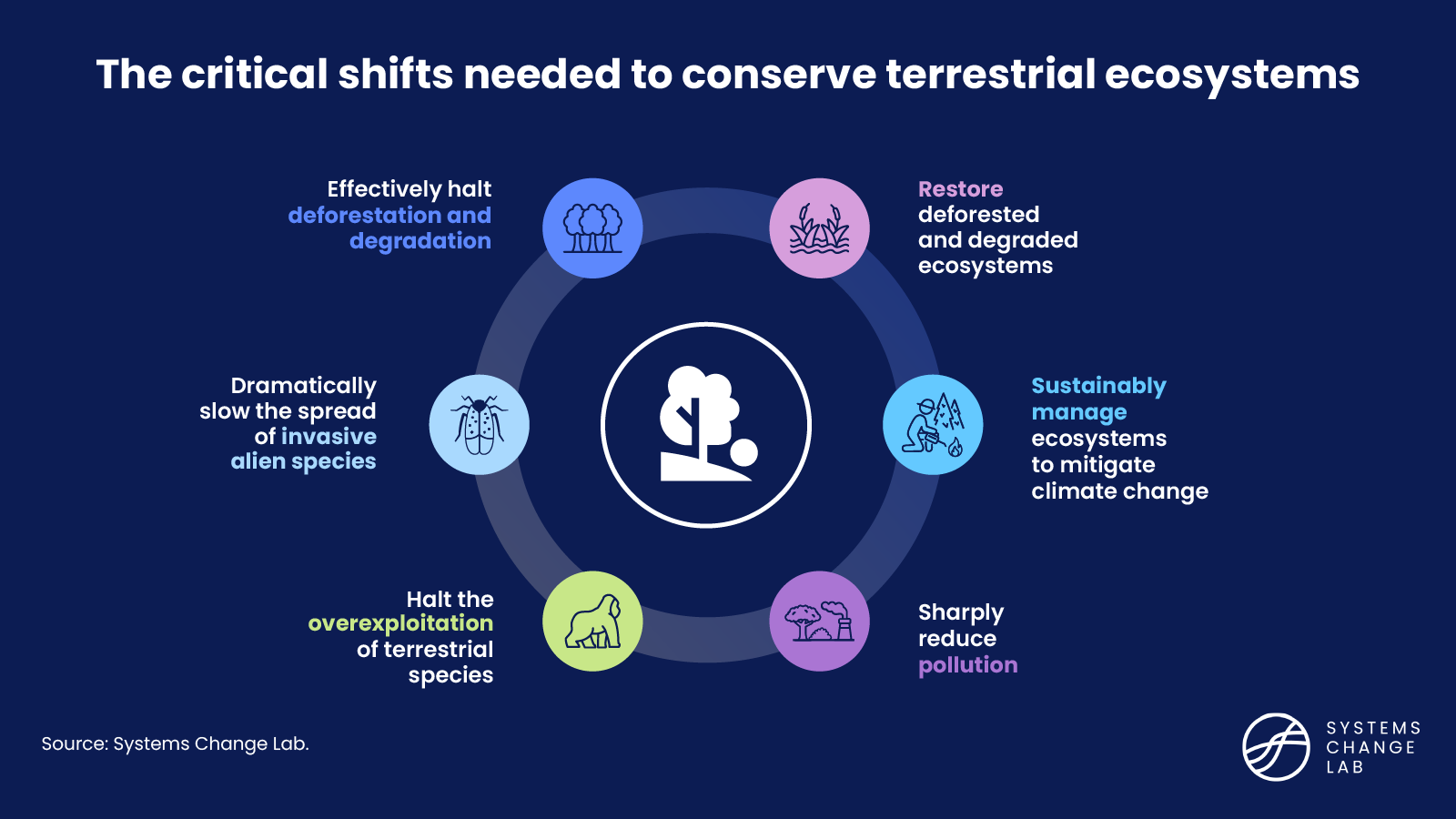
These changes must happen alongside shifts in other systems, especially the global food system, since agricultural expansion is the leading driver of deforestation and degradation across these ecosystems.
Without a coordinated approach, these efforts risk trading one crisis for another — for example, expanding pasture for livestock at the expense of natural grasslands or forests, planting fast-growing trees for carbon at the cost of biodiversity, or expanding protected areas onto farmland without considering local food security or customary land rights.
Finally, this research also identifies more than 65 additional indicators that track conditions that can enable or hinder change. Examples include policies that expand protected areas and strengthen land tenure rights for Indigenous Peoples and local communities; regulations that aim to eliminate deforestation across supply chains; public and private finance for conservation, as well as money flowing into activities that harm biodiversity; and governance measures that help ensure good policies on paper are actually enforced.