The limitations of GDP as a measure of prosperity
For decades, a central goal of the economic system has been the pursuit of economic growth, with gross domestic product (GDP) as the reigning macroeconomic metric. Governments use GDP to guide and monitor economic planning, design and assess the effects of economic policies, prepare national budgets, and compare the health of their economy against other countries. Development financing, debt relief and even UN membership fees are often contingent upon a country’s GDP. Businesses use GDP to monitor the state of the economy and industries and to make strategic decisions.
However, experts have long warned against conflating GDP with prosperity because it does not measure the quality of economic growth as it relates to ecosystem health, sustainability or people’s subjective and objective well-being. While GDP’s growth since 1960 — an increase of more than 7,000% — has been accompanied by benefits like poverty reduction, improved access to health and education, and reduced child mortality, this growth has come at a cost.
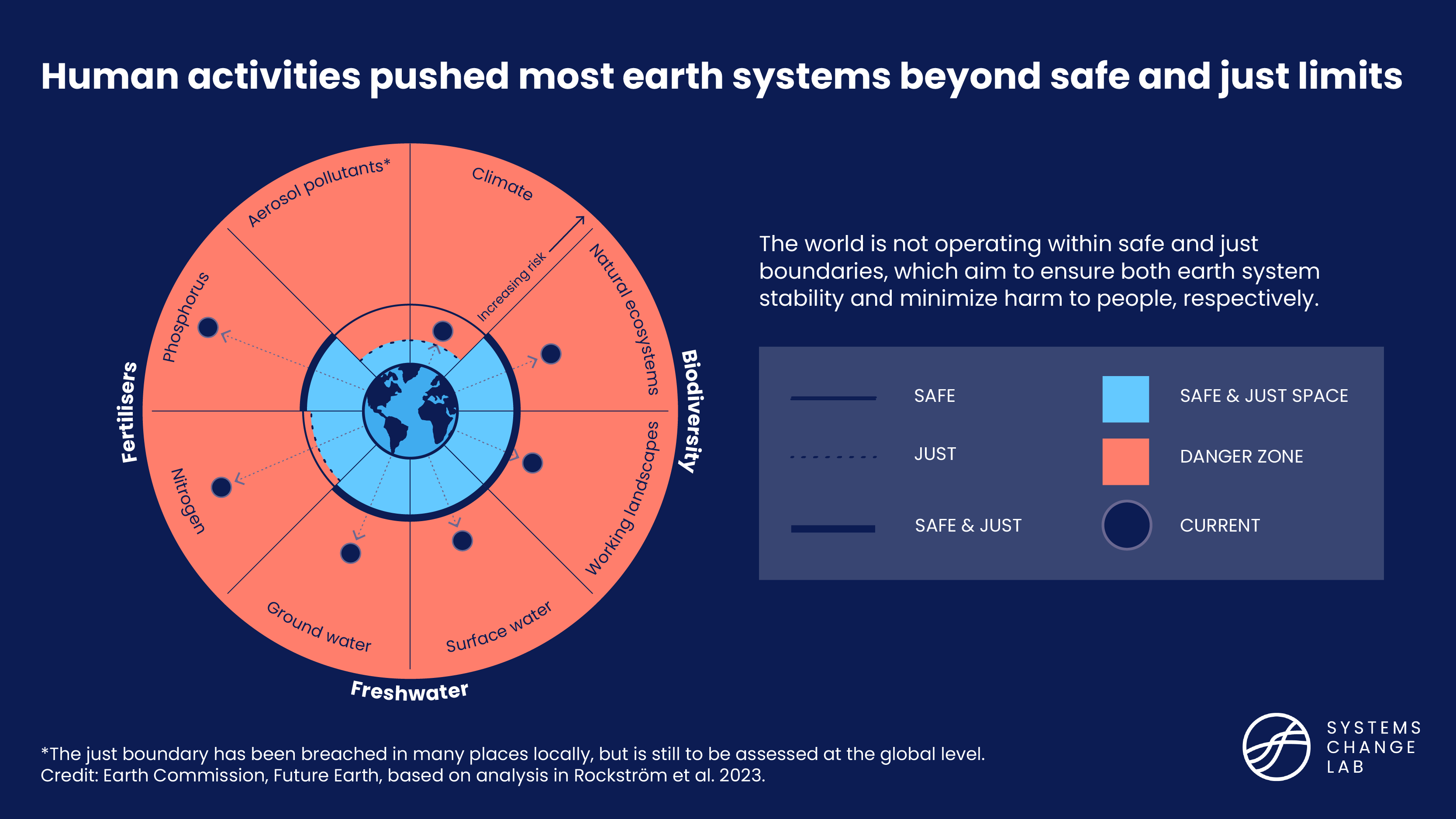
The Sustainable Development Index shows that most of the 163 tracked countries are not achieving human development within ecological limits or planetary boundaries, and 40% of countries have gotten worse over time. Income and wealth inequalities have also been on the rise since the 1980s, resulting in increased political instability and polarization. Recent research from the Earth Commission shows the world is not operating within the safe and just limits of what the planet can afford for seven out of eight earth systems, including climate, aerosol pollutants, natural ecosystems, working landscapes, surface water, groundwater, nitrogen and phosphorus. In other words, global economic development to date has resulted in extreme risks to earth system stability and human livelihoods.
Why GDP remains the dominant economic metric
GDP continues to be the dominant goal for economic planning and policymaking for three primary reasons. First, accounting rules and recommendations for measuring GDP are well-established by the United Nation’s System of National Accounts (SNA). The high degree of international acceptance of the SNA has led to widespread adoption by national statistical agencies, policymakers, international institutions and businesses, and has resulted in frequent conflation of GDP with prosperity.
Second, there is a lack of coordination across researchers, countries and international institutions on alternative progress indicators and “beyond GDP” metrics covering well-being, equity and sustainability dimensions. Most countries track a wide variety of such indicators but vary in terms of indicator selection, data collection and analysis methods, reporting practices, and ability to integrate findings into policymaking processes. Subsequently, there is a lack of comparability across countries for indicators representing dimensions of well-being, equity and sustainability.
And third, countries lack the technical and financial capacity, and sometimes political will, to develop and embed alternative prosperity indicators in their national statistical agencies and economic plans and policies.
How to remove GDP lock-in
To remove GDP lock-in, governments need to systematically integrate well-being, equity and sustainability goals into central economic planning. For instance, governments can work to de-silo policymaking across agencies and consider integrating goals across various national strategies that touch on climate, nature and equity issues (e.g., national development plans, nationally determined contributions and National Biodiversity Strategies and Action Plans). International institutions that support development efforts must also ensure their missions, decision-making processes and results frameworks are tied to these wider goals.
To increase global harmonization and uptake of alternative progress indicators, governments and international institutions can support the creation of a core set or dashboard of internationally-agreed upon well-being, equity and prosperity metrics and associated accounting rules, possibly linked to the UN Sustainable Development Goals. This set of metrics could be elevated to the same international level as GDP to increase acceptance, working through the SNA and satellite accounts.
Current investments and financial flows remain off track to protect people, nature and biodiversity. Watch this webinar recording to learn more.