
Photo by John Modaff/Unsplash
Deforestation, other forms of ecosystem conversion, and degradation are driving biodiversity loss
Terrestrial ecosystems’ vital, often irreplaceable contributions to people range widely, from improving water and air quality to provisioning food and medicines to safeguarding communities from extreme weather events like floods and hurricanes.
Yet human activities — particularly for those that spur direct land-use change, overexploit natural resources, generate pollution and enable the spread of invasive alien species — have triggered steep declines across nearly every facet of biodiversity, jeopardizing ecosystems’ capacity to deliver the very services upon which humanity depends.
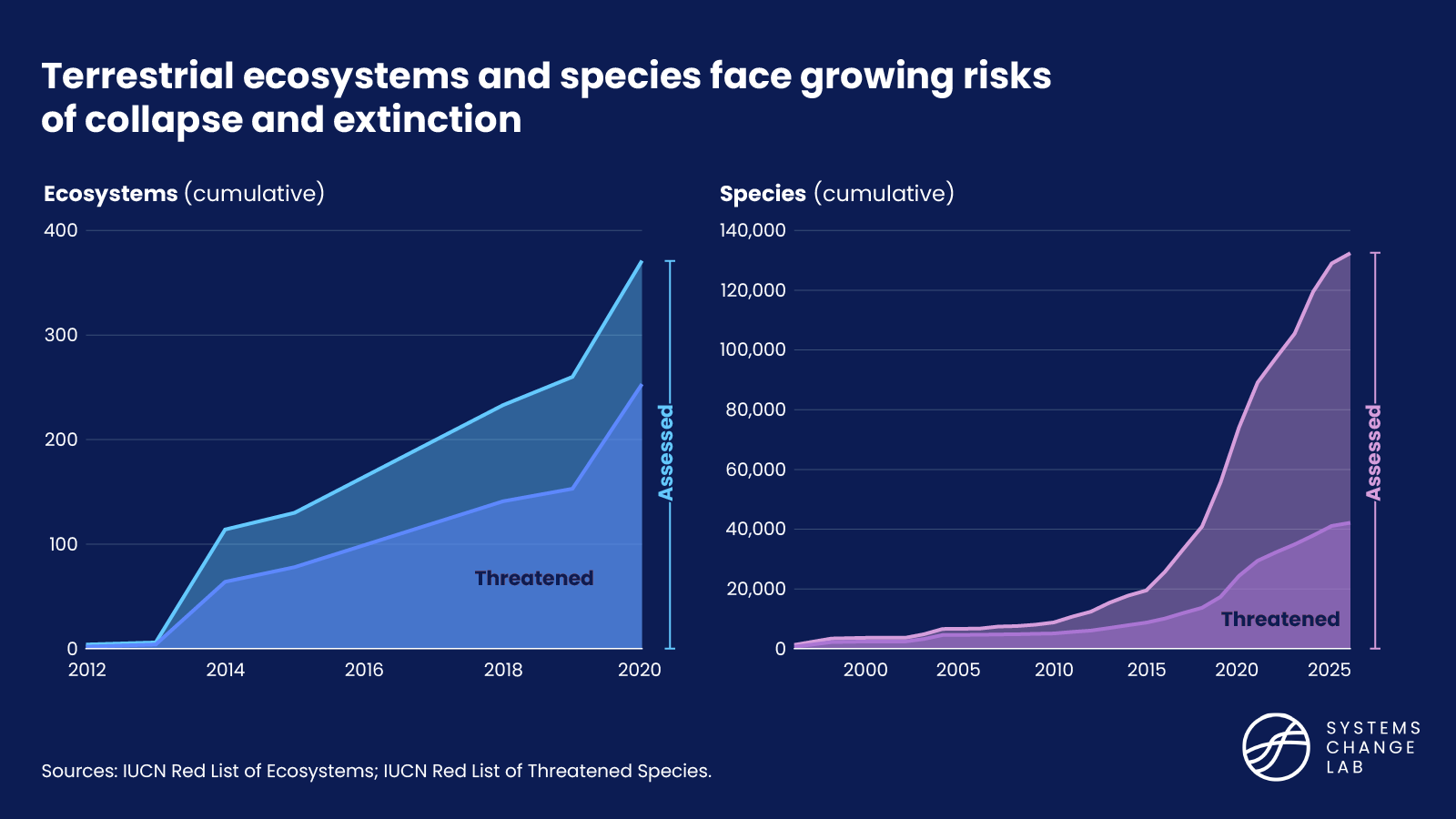
Roughly two-thirds of terrestrial ecosystems assessed now face a heightened risk of ecosystem collapse, while at least 42,000 terrestrial species are currently threatened with global extinction. Without an immediate change in course, the world will likely see these extinction rates, which are already tens to hundreds of times higher than in the past 10 million years, accelerate even faster.
How biodiversity loss and climate change exacerbate each other
Terrestrial biodiversity loss is deeply intertwined with climate change. Each crisis contributes to and exacerbates the other. Rising temperatures, shifting rainfall patterns and more extreme weather events are forcing thousands of species to migrate poleward or to higher elevations, and these range shifts, among other climate impacts, are disrupting ecological functions.
The loss and degradation of these ecosystems, in turn, triggers the release of greenhouse gases (GHGs) into the atmosphere and weakens their ability to continue acting as carbon sinks. For example, in 2023 global temperature rise superimposed onto the warm phase of El Niño-Southern Oscillation brought extreme heat, drought and fires to the tropics, contributing to an unprecedented weakening of the land sink that led to a significant rise in atmospheric concentrations of CO2.
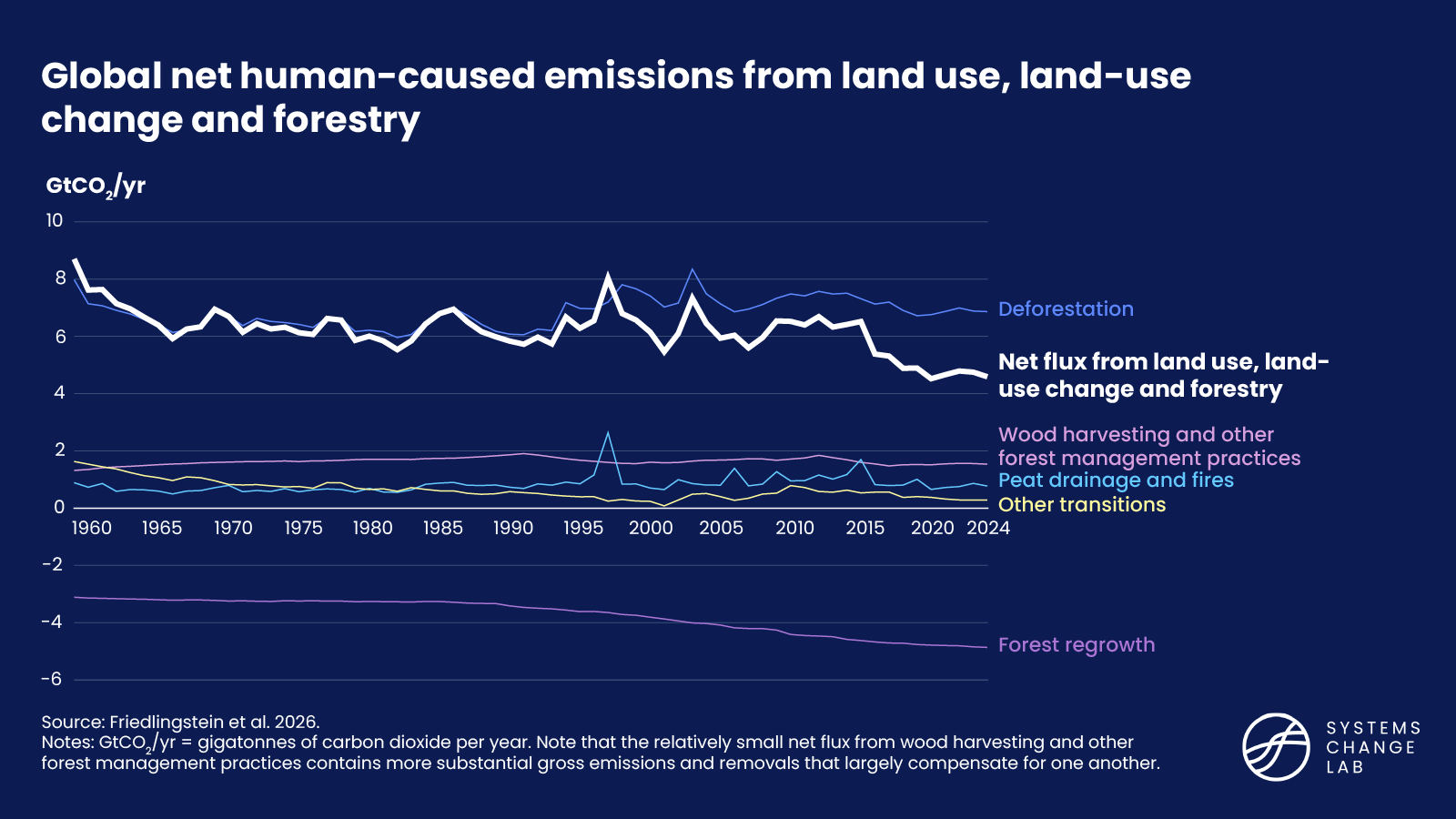
By one estimate from a synthesis of global bookkeeping models, deforestation, peat drainage and peat fires released 7.6 gigatonnes of carbon dioxide (GtCO2) in 2024, while forest (re)growth removed 4.9 GtCO2. Taken together with fluxes from wood harvesting, as well as other forest management practices and other transitions, these net anthropogenic emissions from land use, land-use change and forestry (LULUCF) totaled 4.6 GtCO2 in the same year.
What needs to change immediately to conserve terrestrial ecosystems
To address both crises, the world will need to take immediate action that maximizes co-benefits for climate mitigation and biodiversity conservation, while minimizing harmful trade-offs. The most immediate priority is to effectively halt ecosystem conversion and ecosystem degradation — particularly those that play a critical role in regulating the global climate system, offer climate refugia and migration corridors for threatened species, and contain areas of rich, self-sustaining biodiversity.
Well-designed and appropriately implemented ecosystem restoration, as well as more sustainable management practices, also have a critical role to play in limiting warming to 1.5 degrees C (2.7 degrees F) and safeguarding nature; however, it is critical that these measures complement rather than replace progress made in avoiding future land-use change. To build ecological resilience to future disturbances, including intensifying climate impacts, global efforts must go beyond reducing GHG emissions and enhancing carbon sequestration. They must also tackle other key threats to terrestrial biodiversity by ending the overexploitation of wild species, sharply reducing pollution and slowing the spread of invasive alien species.
Why forests, peatlands, grasslands and coastal wetlands depend on broader systems change
Accelerating these rapid, far-reaching changes across terrestrial ecosystems need to happen in parallel with efforts to transform a range of other systems, from power, industry, transport and buildings to governance, finance and economics.
Among these transitions, the global food system is arguably the most critical to transform, given that agricultural production remains the top driver of land-use change across many terrestrial ecosystems.
Without an integrated approach across these systems, efforts risk trading one crisis for another — such as increasing pasturelands for livestock production at the expense of the world’s grasslands or forests, planting fast-growing trees to maximize carbon sequestration at the cost of forests’ biodiversity, or expanding strictly protected areas across existing farmland to conserve endangered species without considering impacts to local communities’ food security, livelihoods or customary land rights.
Immediate conservation of terrestrial ecosystems is essential to safeguarding the life-sustaining and irreplaceable services they provide to humanity, while helping to address the climate and biodiversity crises.
The shift on invasive alien terrestrial species is not yet available online, as the underlying research is still underway. It represents a critical part of the work and will be published later this year.