Logan Weaver via Unsplash

Equitable systems change is impossible without respect for human rights and civil liberties. These rights set the foundation for all people to access essential services, live in a safe and healthy environment, and participate fully in governance.

Upholding human rights and civil liberties is key for accountable governance

Legal rights establish the state’s responsibilities to its citizens and are therefore the bedrock of accountable governance. This shift considers both the establishment of such rights and the extent of their enforcement and fulfillment. Rather than attempt to encompass the full array of political and social rights, the indicators included here identify key trends that may enable or constrain equitable systems change. A lack of respect for civil liberties may indicate weak rule of law or a shift toward autocracy.
 

Key indicators measuring civic space are heading in the wrong direction

Civic space is under continuous and growing threat, press freedom has deteriorated and attacks on workers’ rights have grown. Just 59% of countries surveyed in 2024 adequately protected their citizens’ freedoms of expression, association and assembly, all of which form the basis for a healthy civil society. This means citizens face severe risks if they attempt to hold the government or industry to account.
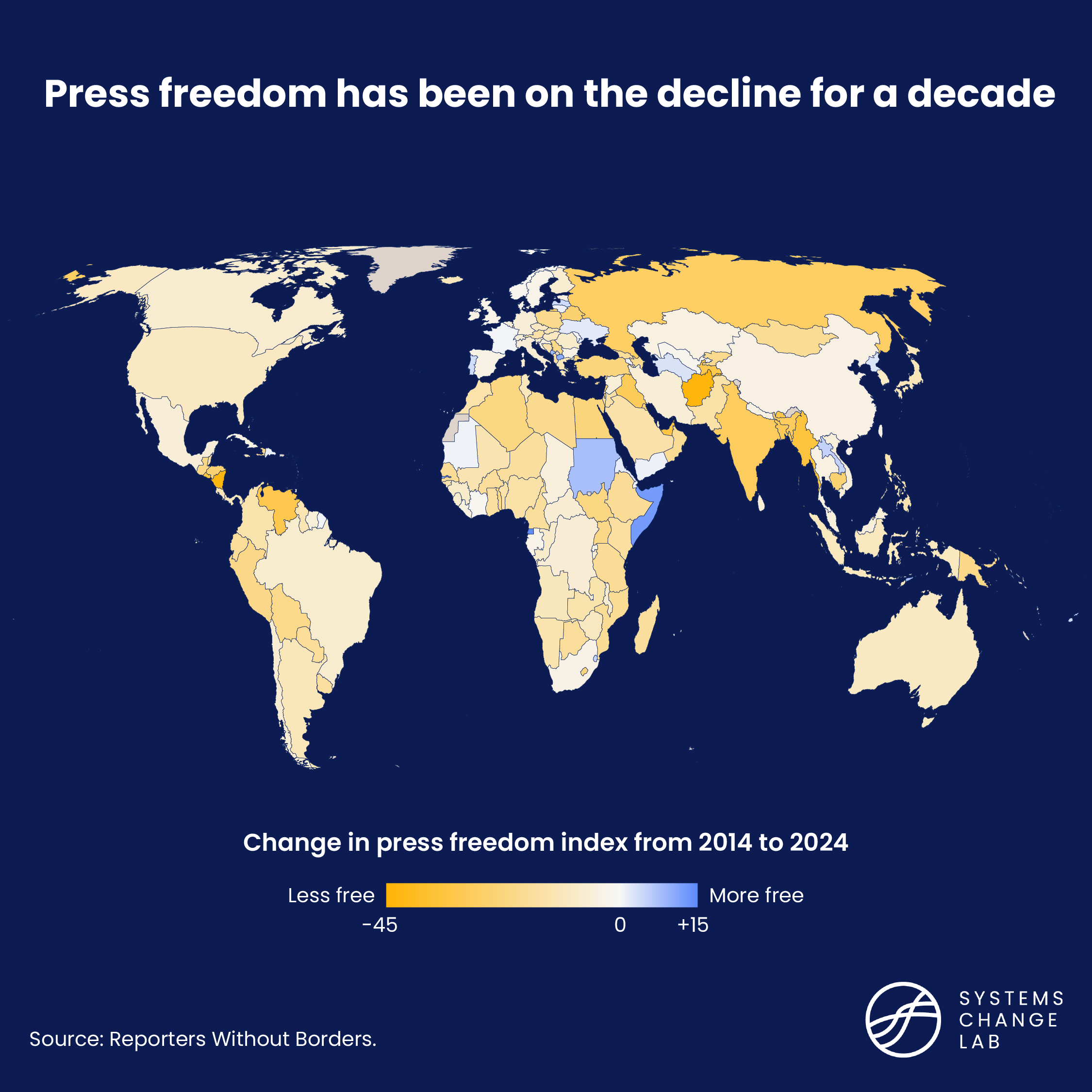
World map depicting decline of press freedom

Despite these deteriorating trends, one key dimension that shows positive signs is the increasing legal recognition of Indigenous and community lands.
 

Human rights defenders on land, environment and climate issues face a high level of risk

One report found that, out of 555 attacks against human rights defenders in 2022, 75% were related to land, environment or climate. In these challenging contexts, civil society and their allies have to employ a politically sensitive approach to identify where progress can be made without risking legal or violent backlash, particularly to ensure the safety of vulnerable actors or groups. Recent work from Pact and its partners demonstrates that applied political economy analysis can be used to strengthen critical human rights response mechanisms, such as human rights treaty bodies or domestic bodies such as ombudspersons, even in contentious settings.

Achieving goals for people, nature and climate requires respecting human rights
If governments ignore or undermine human rights, they are less likely to reach climate and nature goals in ways that are socially equitable. These rights help ensure accountability, strengthen the social contract and establish the foundation for universal social welfare, security and inclusive participation in governance. This starts by halting crackdowns on protests and dissent; reforming laws that restrict expression, association or assembly; and preventing physical and legal threats against activists, journalists and labor organizers. It is essential to strengthen legal protections, enhance institutional capacity and cultivate political leadership that embeds a culture of respect for human rights across government. At the same time, companies must be held accountable for upholding these rights across their supply chains as well.


Indicators in this shift are all directional, with an increasing trend indicating improvements in the environment for workers, civil society and communities. While there are no specified global targets or timeframes, equitable systems change can only occur if these key measures of human rights and civil liberties show rapid improvement.

Tracking progress on global outcomes

3448: Countries legally recognizing land tenure rights for Indigenous Peoples and local communities

Status: Right Direction
Historical Data Methodology and Challenges:

The Rights and Resources report is currently the only source of global data on community land tenure. The number of countries included (73) is limited by available data.

Securing land tenure rights for Indigenous Peoples and local communities (IP&LCs) not only provides a basis for local livelihoods and food production, but also tends to reduce deforestation and land degradation, especially when tenure security is enforceable. This indicator includes countries that legally protect land ownership by IP&LCs and countries that designate land to IP&LCs for use. The distinction is that simply designating it for use by IP&LCs does not always include rights to exclude outside use, to due process and compensation, or to retain rights for an unlimited duration. Land titles themselves are only the starting point for tenure security, which requires collaboration and coordination between government agencies, communities and relevant industrial actors, and capacity, resources and political support to enforce tenure rights, among other enabling conditions.

Secure land rights is a critical indicator for considering how climate, nature and equity goals will be met. According to the most recent data, of the 73 countries surveyed in 2020 (accounting for 85% of the world’s land), 58 legally recognized designation and/or ownership rights of IP&LCs, up from 56 countries in 2015.

Importantly, such recognition of legal rights does not necessarily mean that a country has implemented them effectively across its territory. Researchers estimate that if existing legal frameworks were fully implemented in 19 countries, over 260 million hectares (Mha) of land — land that is already under community customary rights or claims — could be formally recognized, more than doubling the area acknowledged between 2015 and 2020 across the 73 surveyed countries.

On a positive note, the growth in legal recognition still means that the total area of land under community control increased by 103 Mha from 2015 to 2020, resulting in 800 Mha designated for, and 1176.1 Mha owned by local communities as of 2020.

3477: Countries with minimal civic space protections

Status: Wrong Direction
Historical Data Methodology and Challenges:

Data was extracted from Civicus Monitor’s People Power Under Attack series.

The number of countries included in the study in 2018-2020: 196 countries; 2021-2022: 197 countries; 2023-2024: 198 countries. 

We included countries rated “Open,” “Narrowed” or “Obstructed,” because even under the report’s category of “obstructed,” citizens “can organize and assemble peacefully” and there is “some space for non-state media and editorial independence.” These conditions could still allow for system change for nature, climate and people, though in a more challenging context. However, it is important to note that many of the countries included in this definition could make significant improvements to ensure that all voices can be heard without risk of harassment, legal threat or violence. As the same report authors note, in “obstructed” countries, citizens “are vulnerable to frequent use of excessive force by law enforcement agencies, including rubber bullets, tear gas, and baton charges,” and “journalists face the risk of physical attack and criminal defamation charges.”

The full methodology may be accessed here.

The United Nations defines civic space as “...an environment that enables people and groups — or “civic space actors” — to participate meaningfully in the political, economic, social and cultural life of their societies.” Without the civic space through which civil society can participate and hold governments and industry accountable, climate and nature commitments, human rights, and scientific evidence can be easily ignored or flouted if political elites do not share these concerns.

Based on data from Civicus Monitor’s People Power Under Attack series, the share of countries protecting civic space to any notable extent — those not rated “repressed” or “closed” — has decreased in recent years, down from 70% in 2018 to 59% in 2024. This means that communities that speak up to protect the health and well-being of their communities — or in some cases, against poorly conceived or executed climate solutions — are facing graver and more consistent threats to their freedom, health and security.

3449: Countries protecting press freedom

Status: Wrong Direction
Historical Data Methodology and Challenges:

Number of countries included in the Reporters Without Borders (RSF) study in 2013: 179 countries. 2014-2025: 180 countries. Data prior to 2013 was excluded due to a change in methodology.

RSF scores countries on a scale of 100, with 100 being the highest possible level of press freedom. Scores are produced based on a quantitative tally of different types of abuses against journalists and a qualitative analysis of the country’s legal, political, economic and social contexts and the degree to which they enable or impede freedom of press. Countries that scored above 55 points (“good,” “satisfactory” or “problematic”) were included in our selection criteria as indicative of a moderate level of press freedom. Systems Change Lab authors also evaluated SDG Indicator 16.10.1 — "Number of verified cases of killing, kidnapping, enforced disappearance, arbitrary detention and torture of journalists, associated media personnel, trade unionists and human rights advocates in the previous 12 months” — however, there is a dearth of reported data as of 2025.

A free press contributes to good governance by promoting transparency and accountability of the public and private sectors, creating visibility and awareness of social and environmental problems, and providing a forum for all voices to be heard.

As monitored by Reporters Without Borders (RSF), annual press freedom scores are based on a quantitative analysis of abuses against journalists over the previous year and a qualitative analysis based on a questionnaire sent to press freedom experts. The share of countries that scored at least 55 on RSF’s scale of 100, with 100 being the highest possible level of press freedom, peaked between 2013-2015 at 84% and declined to 50% by 2025.

RSF's 2026 report particularly highlighted increases in attacks from political actors, including disinformation campaigns to undermine independent media, restricting access through social media and the internet, direct harassment, and flouting of principles of protection of journalists during conflict. Numerous reports from UNESCO, the Committee to Protect Journalists and others similarly emphasize the continuing downward trend in press freedom and threats facing journalists across the world.

3478: Countries respecting workers’ rights

Status: Wrong Direction
Historical Data Methodology and Challenges:

Number of countries included in the study in 2021-2022: 148 countries; 2023: 149 countries; 2024: 151 countries.

ITUC’s assessment framework includes six categories, from 1 to 5+, with higher scores indicating a greater violation and eradication of workers’ rights, all the way to 5+, which indicates no guarantee of rights due to a breakdown of the rule of law. Here, our threshold for countries that respect workers’ rights includes those that score 1, “Sporadic violations of rights,” or 2, “Repeated violations of rights.” A score of 3 indicates regular violations of rights, 4 indicates systematic violations of rights and 5 indicates no guarantee of rights.

Target Methodology:

SDG Target 8.8 does not set a quantified target for the enforcement of labor rights’ protections. This indicator thus measures whether enforcement of internationally recognized labor rights is expanding or contracting.

The International Labor Organization’s fundamental principles and rights at work include the freedom of association, recognition of right to collective bargaining, elimination of forced labor and child labor, the elimination of discrimination in the workplace, and a safe and healthy working environment. These principles are reflected in Sustainable Development Goal (SDG) Target 8.8, and the United Nations affirms that the fulfillment of these rights is critical for advocating for greater income equality, safe working conditions, and fair and equitable treatment of different groups.

Social equity and a just transition cannot be achieved without securing workers’ rights. Yet, according to a report by the International Trade Union Confederation, there has been a significant rise in violations of workers’ fundamental rights. As of 2024, only 19% of the 151 surveyed countries demonstrated consistent respect for workers’ rights. This number is down from 26% in 2021, suggesting that this indicator is headed in the wrong direction.

While the global trends can mask improvements in some countries and regions, primary drivers of the decline include economic globalization, reduced union membership and political power of labor unions in some countries, automation, and regulatory capture of the authorities who are responsible for enforcing working conditions.

Significant progress must be made in many countries to protect the rights of workers if just transitions are to be realized. Reversing these trends will require action from business leaders and investors to conduct due diligence across their supply chain and investee companies, and from governments to legislate and enforce workers’ rights and set clear visions for the rights of workers in just transition plans.

Key enablers and barriers to change

Other shift Other shifts needed to transform the system

Ensure transparency and access to information

Transparency and access to information are essential for effective government coordination, meaningful participation from civil society and building international trust and cooperation.

Guarantee access to justice

An independent, impartial and accessible justice system is a critical tool for individuals and communities to protect their rights and obtain justice.

Promote government accountability and anti-corruption measures

To implement ambitious policies effectively and mobilize public finance for climate, nature and equity, governments must follow through on commitments and enforce laws consistently — even for those with political and economic power.

Ensure inclusive citizen participation in policymaking and political processes

The ability of any individual or social group to participate meaningfully in political and policymaking processes is a fundamental recognized human right — and a powerful way to advance the voices of those most affected by climate change, social inequality and loss of nature.

Strengthen government capacity to implement commitments fairly and effectively

Governments should build their capacity to collect tax revenues fairly, secure their borders effectively and maintain skilled bureaucracies that can plan, coordinate, regulate and adapt to new information and technology.