Colin Lloyd via Unsplash

An independent, impartial and accessible justice system is a critical tool for individuals and communities to protect their rights and obtain justice.

An independent judicial system is key for environmental and climate justice

Judiciaries are integral for safeguarding the rights of all citizens, ensuring the rule of law is applied across society and providing important checks on the powers of lawmakers and the executive branch. When there are conflicts on the application or enforcement of laws impacting climate, nature or social equity, judiciaries are often the last bastion for citizens to seek justice.

Access to justice in the context of nature and climate is often about the resolution of disputes and enforcement of the law in ways that have direct equity implications. Environmental disputes are especially complex because they frequently concern natural resources vital to communities that have historically been disadvantaged.

An United Nations Environment Programme report on environmental rule of law identifies three main challenges to accessing justice in environmental matters: financial, geographical or jurisdictional barriers, such as legal standing; lack of capacity or accessibility of lawyers, judges and technical experts; and lack of government resources to invest in rule of law infrastructure — i.e., making sure the public is aware of available mechanisms and publicizing court decisions.
 

Climate litigation is growing but obstacles remain

To ensure action toward climate goals, civil society must be able to use courts to challenge public and private actors. A 2023 assessment of climate litigation trends showed that over 2,300 climate litigation cases had been filed to date, and of the 549 with a decided verdict, over 50% were favorable to climate action.

However, companies and other actors accused of human rights violations or environmental harms also use the courts to silence or sanction critics in what are often referred to as “strategic lawsuits against public participation” (SLAPPs). One report identified 355 SLAPPs between 2015 and 2021, 65% of which were related to mining, agriculture and livestock, logging and lumber, and palm oil sectors, and others have reported similar findings.

The indicators in this shift together suggest that most of the world’s population still lacks timely and affordable access to courts and tribunals that are independent and free from improper influence or corruption. In 2024, less than 40% of the 140 surveyed countries had reliable access to timely and affordable justice that was free from improper influence, corruption or discrimination and was effectively enforced. Of the indicators, only affordability is trending in the right direction. Alternative dispute mechanisms — which can help settle disputes without the costs of litigation — is the only indicator where most countries are demonstrating effective implementation.
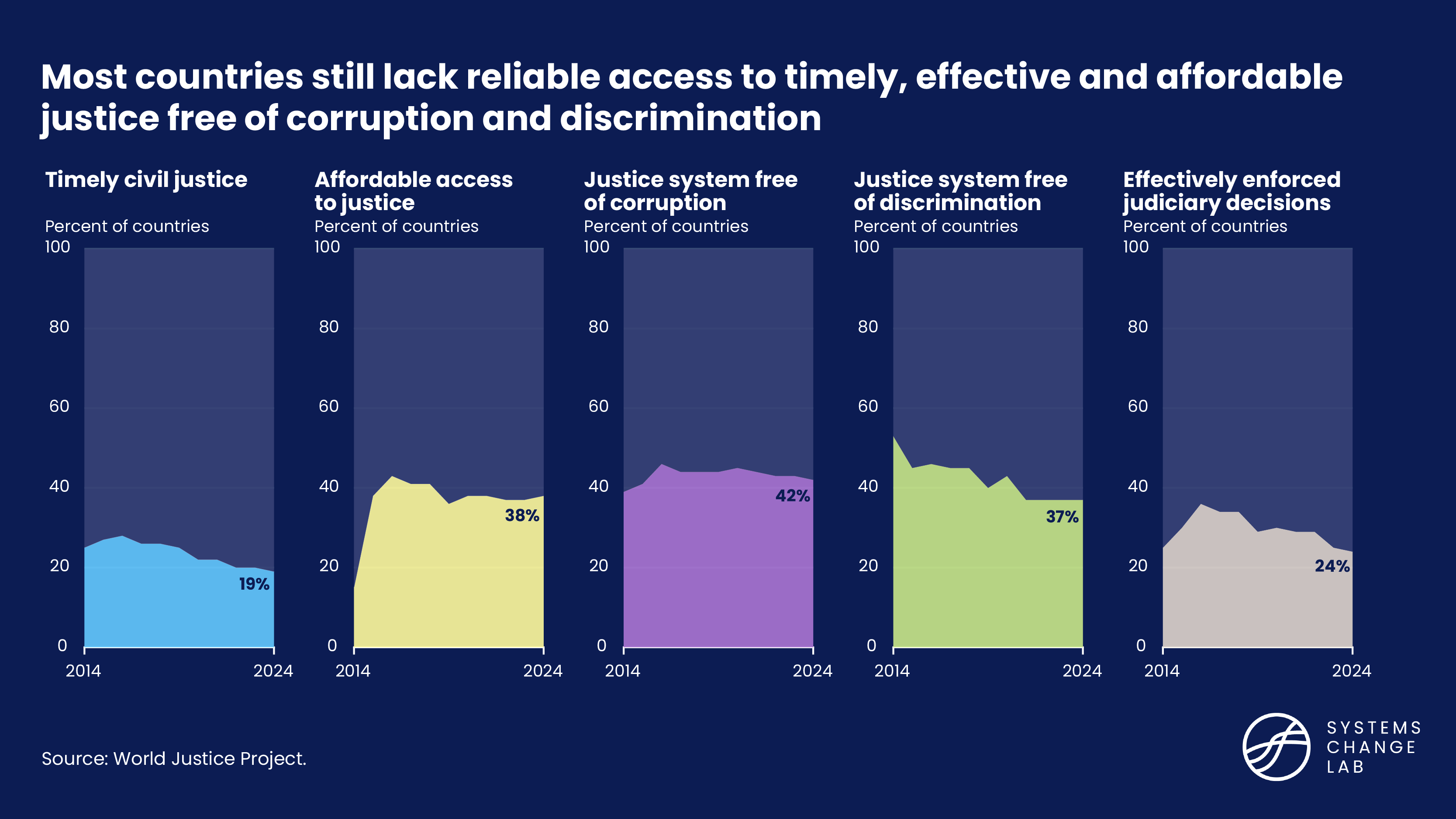
Five time series graphs of global justice trends


A range of measures can help overcome barriers to justice, enabling access for all

Governments can undertake a wide range of measures to make the justice system more accessible and responsive to all citizens. This includes, for instance, granting legal standing to concerned citizens, communities, Indigenous groups or others; establishing independent and impartial courts; and ensuring that judges possess the legal, scientific and/or technical expertise necessary to adjudicate complex issues.

Some countries, including Bolivia, Colombia, Ecuador, New Zealand and local governments in the United States, have gone beyond granting legal standing to individuals to bring environmental cases in the public interest, and have given standing to nature generally or specific ecosystems.

Easing the financial burden can also make the judicial system more accessible to all, such as by setting reasonable court fees, waiving fees for indigent or public interest plaintiffs, and ensuring affordable legal aid.


The indicators in this shift are all directional, with an increasing trend indicating improvements in access to justice. While there are no specified global targets or timeframes, robust and effective mechanisms to protect the rights of communities, as well as environmental and climate defenders, can only be realized if these key measures of the justice system show rapid improvement.

Tracking progress on global outcomes

3452: Countries with affordable access to civil justice

Status: Right Direction
Historical Data Methodology and Challenges:

Data from the Rule of Law Index is available beginning in 2012. To maintain a more consistent country sample over time, Systems Change Lab presents data from 2021 onward. The number of countries included in each year varies: 139 countries in 2021, 140 countries in 2022, 142 countries in 2023 and 2024, and 143 countries in 2025.

Countries that scored over 0.6 out of 1.0 (1.0 being the highest possible score) were included in the selection criteria as indicative of accessible alternative dispute mechanisms. This threshold was determined by Systems Change Lab and WJP.

The World Justice Project (WJP) measures to what extent people are aware of aid and support for legal advice and representation and can access the court system without unreasonable fees or procedural, linguistic or physical barriers. This indicator has important bearing for equity: if poor plaintiffs or small civil society organizations cannot bring forward cases due to cost or other barriers, their voices and concerns may be silenced.

According to WJP, in 2025, 38% of the 143 surveyed countries scored above average on affordable access to justice. The past five years of data suggest that progress on this indicator is now headed slightly in the right direction.

3453: Countries with timely civil justice

Status: Wrong Direction
Historical Data Methodology and Challenges:

Data from the Rule of Law Index is available beginning in 2012. To maintain a more consistent country sample over time, Systems Change Lab presents data from 2021 onward. The number of countries included in each year varies: 139 countries in 2021, 140 countries in 2022, 142 countries in 2023 and 2024, and 143 countries in 2025.

Countries that scored over 0.6 out of 1.0 (1.0 being the highest possible score) were included in the selection criteria as indicative of accessible alternative dispute mechanisms. This threshold was determined by Systems Change Lab and WJP.

Environmental court cases can take years to be resolved, potentially forcing individuals or small organizations lacking financial resources to drop suits or be dissuaded from pursuing them in the first place. The timeliness of carrying out civil justice is therefore a critical component of a fair and effective justice system.

This typically entails taking measures to ensure that cases or judicial actions are not excessively delayed or stretched out over the course of years. What is considered “timely” is somewhat subjective based on the country context, but broadly can be defined as less than one year.

According to the World Justice Project (WJP), the share of countries where civil justice judgements were delivered in a timely fashion peaked in 2021 with 22% of the 139 surveyed countries scoring well, then steadily declined to 18% of the 143 surveyed countries in 2025. The past five years of data suggest that this indicator is headed in the wrong direction.

3454: Countries with civil justice free from improper government influence

Status: Wrong Direction
Historical Data Methodology and Challenges:

Countries that scored >0.6 on a scale of 0.0 (lowest) to 1.0 (highest) were included in the selection criteria as indicative of countries that have civil justice that is free from improper government influence. This threshold was determined jointly via expert judgment by Systems Change Lab and WJP researchers. 

Data is available beginning in 2012, but to maintain a more consistent country sample, Systems Change Lab presents data from 2021 onward. The number of countries included in each year varies: 139 countries in 2021, 140 countries in 2022, 142 countries in 2023 and 2024, and 143 countries in 2025. The numerator reflects the number of countries that scored >0.6, while the denominator includes all countries with scores in a given year.

This indicator assesses whether courts are susceptible to improper influence from government officials or politicians. Without independence and impartiality, the justice system may reinforce the interests of politically and economically powerful actors rather than uphold the rule of law. Effective grievance mechanisms are less likely in countries where judges or judicial officials collect economic rents, kickbacks or political favors from political actors invested in deforestation or carbon-intensive activities.

According to the World Justice Project, in 2025, only 36% (52) of the 143 surveyed countries were found to be free from improper government influence, and this number has been relatively unchanged since 2021. Nonetheless, the trend has been slightly negative over the last five years, down from 38% in 2021 (when 139 countries were surveyed).

3455: Countries with civil justice free of corruption

Status: Wrong Direction
Historical Data Methodology and Challenges:

The World Justice Project (WJP) Rule of Law Index measures three forms of corruption — bribery, undue influence by public or private interests, and misappropriation of public funds or other resources — across the executive, judicial and legislative branches, as well as within the police and military. Its data is constructed through general population polls and expert questionnaires to capture perceptions of and experiences with corruption in a given country. However, this approach to measuring corruption remains challenging due to definitional issues and that corruption itself is not directly observable. Countries that scored >0.6 on a scale of 0.0 (lowest) to 1.0 (highest) were included in the selection criteria as indicative of countries that have relatively low levels of corruption. This threshold was determined jointly via expert judgment by Systems Change Lab and WJP researchers. Finally, data is available beginning in 2012, but to maintain a more consistent country sample, Systems Change Lab presents data from 2021 onward. The number of countries included in each year of data varied: 139 countries in 2021, 140 countries in 2022, 142 countries in 2023 and 2024, and 143 countries in 2025. The numerator reflects the number of countries that scored >0.6, while the denominator includes all countries with scores in a given year.

When civil justice is free of corruption, the justice system is not vulnerable to influence from bribes or other types of influence from the private sector. Given the evidence that corruption is widespread and systemic across the extractives and natural resources management sectors, it is important to consider to what extent the justice system has proven resilient to private sector influence.

In 2025, 43% of the 143 surveyed countries had a civil justice system that was considered free from corruption, according to the World Justice Project. Though this number has remained relatively stagnant since 2021, it slightly decreased over the past five years, indicating that it is headed in the wrong direction.

3456: Countries with civil justice free of discrimination

Status: Right Direction
Historical Data Methodology and Challenges:

Data from the Rule of Law Index is available beginning in 2012. To maintain a more consistent country sample over time, Systems Change Lab presents data from 2021 onward. The number of countries included in each year varies: 139 countries in 2021, 140 countries in 2022, 142 countries in 2023 and 2024, and 143 countries in 2025.

Countries that scored over 0.6 out of 1.0 (1.0 being the highest possible score) were included in the selection criteria as indicative of civil justice that is free of discrimination. This threshold was determined by Systems Change Lab and WJP.

This indicator assesses public and expert perceptions of whether the civil justice system in a given country discriminates based on socioeconomic status, ethnicity, religion, gender identity, sexual orientation or national origin. This provides a gauge of the extent to which there is equitable access to justice, or if discriminatory social norms prevent certain groups from receiving fair treatment.

According to the World Justice Project (WJP), only 39% of 143 countries surveyed in 2025 were considered to have civil justice systems free of discrimination, up from a recent high of 37% in 2021. A gradual increase in freedom from discrimination over the past five years suggests that this indicator is headed in the right direction.

3457: Countries with effectively enforced civil justice

Status: Wrong Direction
Historical Data Methodology and Challenges:

Data from the Rule of Law Index is available beginning in 2012. To maintain a more consistent country sample over time, Systems Change Lab presents data from 2021 onward. The number of countries included in each year varies: 139 countries in 2021, 140 countries in 2022, 142 countries in 2023 and 2024, and 143 countries in 2025.

Countries that scored over 0.6 out of 1.0 (1.0 being the highest possible score) were included in the selection criteria as indicative of civil justice that is effectively enforced. This threshold was determined by Systems Change Lab and the World Justice Project.

Civil cases are those in which plaintiffs seek to redress harms and hold actors accountable, such as through compensation, restitution and similar measures. This indicator measures whether country experts and the general public think that judicial decisions in such cases are enforced effectively and in a timely manner. If decisions that would halt environmental, climate or human harm cannot be trusted to be enforced, then the justice system will not be seen as a reliable or an effective check on abuses of power.

According to the World Justice Project, approximately 23% of 143 countries surveyed in 2025 were considered to exhibit effective enforcement of judicial decisions. This demonstrates a significant decline from 29% of 139 countries surveyed in 2021. Some of this decline can be attributed to a wider survey of countries, including countries that scored lower on this indicator.

3458: Countries with accessible, impartial and effective alternative dispute mechanisms

Status: Wrong Direction
Historical Data Methodology and Challenges:

Data from the Rule of Law Index is available beginning in 2012. To maintain a more consistent country sample over time, Systems Change Lab presents data from 2021 onward. The number of countries included in each year varies: 139 countries in 2021, 140 countries in 2022, 142 countries in 2023 and 2024, and 143 countries in 2025.

Countries that scored over 0.6 out of 1.0 (1.0 being the highest possible score) were included in the selection criteria as indicative of accessible alternative dispute mechanisms. This threshold was determined by Systems Change Lab and WJP.

Alternative dispute mechanisms include negotiation, mediation, arbitration and similar forms of dispute resolution that avoid going to court and often take less time and money to resolve, as long as both parties agree to the terms of how the dispute resolution will be decided.

For example, according to one study, the United States Environmental Protection Agency has made frequent use of alternative dispute resolution over the decades and there has been generally high levels of satisfaction among participating parties. More recently, alternative dispute resolutions have also shown to be an effective alternative for environmental cases in Nigeria.

Of the 143 countries surveyed by the World Justice Project (WJP) in 2025, 68% enjoyed relatively strong access to alternative dispute mechanisms.

Key enablers and barriers to change

Other shift Other shifts needed to transform the system

Enable a safe and secure environment for workers, civil society and communities

Equitable systems change is impossible without respect for human rights and civil liberties. These rights set the foundation for all people to access essential services, live in a safe and healthy environment, and participate fully in governance.

Ensure transparency and access to information

Transparency and access to information are essential for effective government coordination, meaningful participation from civil society and building international trust and cooperation.

Promote government accountability and anti-corruption measures

To implement ambitious policies effectively and mobilize public finance for climate, nature and equity, governments must follow through on commitments and enforce laws consistently — even for those with political and economic power.

Ensure inclusive citizen participation in policymaking and political processes

The ability of any individual or social group to participate meaningfully in political and policymaking processes is a fundamental recognized human right — and a powerful way to advance the voices of those most affected by climate change, social inequality and loss of nature.

Strengthen government capacity to implement commitments fairly and effectively

Governments should build their capacity to collect tax revenues fairly, secure their borders effectively and maintain skilled bureaucracies that can plan, coordinate, regulate and adapt to new information and technology.