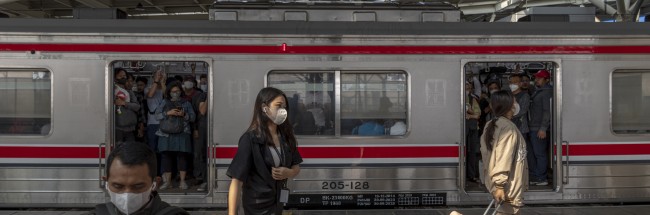
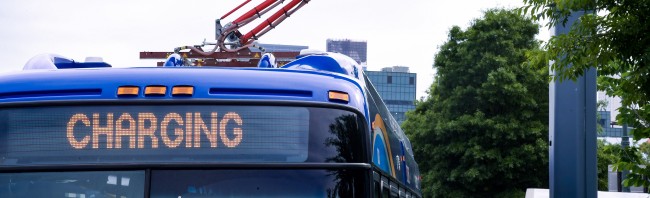
Photo by Climate Group via Flickr

All people deserve access to opportunities via safe transport and convenient mobility options. The transition of the world’s energy systems to decarbonized travel modes must be accomplished equitably in a way that enhances access to opportunity for everyone.

Access to safe public transport and mobility is a basic need and is recognized as such by the U.N.’s Sustainable Development Goal (SDG) 11.2. It’s essential for participation in economic, social and cultural activities. Vulnerable individuals — including women, children, residents of lower-income and communities of color, persons with disabilities and older persons — need special attention to ensure access.

Accessibility is important to the success of decarbonization and is a goal in and of itself. 

It is important that the transition of the world’s energy systems to decarbonized modes of travel is accomplished equitably and in a way that provides opportunity for everyone.

In many countries, transport systems have been built to favor automobiles and rapid personal travel. Often, planners have overlooked how these individualized transport investments benefit persons at every income level, especially poor, marginalized people. Research from cities in the U.S., Brazil, Kenya and Mexico shows high-income residents enjoy better access to jobs and other opportunities due to the location of housing and transit infrastructure. Countries and cities need to prioritize transport systems that provide equal access to opportunities.

Safety is just as important in a decarbonized world as it is in our current system. 

All road users — including cyclists and pedestrians — deserve access to safe mobility options. Although road fatalities have slowly declined in recent years, they are still a long way from zero. And the downward trend is not universal: in some countries, like the U.S., vehicles are becoming larger on average, and therefore more dangerous to pedestrians, cyclists and smaller vehicles.

Tracking progress on global outcomes

2223: Access to green mobility for underserved or marginalized communities

Status: Insufficient Data

An equitable transition to a zero-carbon transport system requires that all segments of society benefit, including lower-income and disadvantaged communities. Although Sustainable Development Goal (SDG) 11.2 centers on providing access to sustainable transport systems for all, it is equally important to measure the level of access to sustainable mobility for lower-income and disadvantaged communities.

This could take the form of equitable access to public transport, accounting for factors such as ethnicity and socio-economic status. Although no global dataset has been identified, some regions provide illustrative examples. For example, the U.S. Department of Transportation’s Equitable Transportation Community Explorer estimates that 35% of census tracts (4,000 people each) in the United States are transportation disadvantaged.

Many communities, not only those in developing countries, rely on the informal transport sector, such as microbuses and motorcycles, for their mobility. Informal systems play an important role in serving residents’ mobility needs, and documenting access to these systems can help inform planning and interventions to improve safety and security and better address environmental challenges.

Access to green mobility may also relate to public charging infrastructure for electric vehicles (EVs) used by renters, residents in multi-unit dwellings or residents without dedicated parking in lower-income and disadvantaged communities. The access gap to public EV charging stations for Black and Hispanic communities in the U.S. is well-documented in New York, California and Chicago.

Comprehensive, high-resolution modeling evaluating the environmental justice and energy equity of the nationwide EV charging infrastructure in the U.S. is being developed by the National Renewable Energy Laboratory (NREL), but no aggregate indicators have been identified. As EV penetration increases in a growing number of countries, equity issues in access to EV infrastructure could grow if these discrepancies are not addressed.

1914: Road fatalities

Status: Well Off Track
Historical Data Methodology and Challenges:

Collected data from the World Health Organization on estimated road fatalities globally and by country. Because data is not publicly available for 2021, we calculated progress toward the target from the latest available data point, which was from 2019.

Heavy reliance on road transport and interaction between vehicles and cyclists or pedestrians brings the danger of road fatalities.

Annual global road fatalities were about 19 per 100,000 people from 2000–2003 and declined to 16.7 per 100,000 people in 2019 (the most recent year of data). The number includes pedestrian, cyclist, motor vehicle and other road injuries, with pedestrian and cyclist fatalities accounting for nearly half of the total. It has been shown that communities of color and lower-income communities are disproportionately affected by pedestrian fatalities.

In 2015, Sustainable Development Goal (SDG) 3.6 called for halving the number of global deaths and injuries from road traffic accidents between 2010 and 2020, but this goal was not reached. The number of fatalities per 100,000 people only fell about 8 percent from 2010 to 2019. In 2021, a renewed effort began to halve deaths from road accidents from 2021 levels by 2030. Recent progress needs to accelerate by more than 10x to meet the 2030 goal.

Key enablers and barriers to change

2124: Population with safe and convenient access to public transport and infrastructure

Historical Data Methodology and Challenges:

Data was collected from the annual UN Sustainable Development Goal (SDG) reports. The 2018 data is sourced from the SDG 2019 report, based on data from 227 cities. The 2019 data is sourced from the SDG 2021 report, based on data from 610 cities. The 2020 data is sourced from the SDG 2022 report, based on data from 1,510 cities.

As of 2020, only 51.6% of the world’s urban population had convenient access to public transport. In Sub-Saharan Africa and Central and Southern Asia, only 31% and 34% of the population, respectively, had convenient access to transport in urban areas.

Because transport emissions account for 15% of global greenhouse gas (GHG) emissions, improving access to public transport will not only improve livelihoods and equity outcomes, but also mitigate climate change by reducing emissions. Additionally, access to high quality transport can reduce road fatalities, as cities with higher public transit use have lower traffic fatality rates.

This indicator measures access to public transport as the share of the population within 500 meters walking distance of low-capacity transport systems (buses and trams) and 1,000 meters distance to high-capacity systems (trains, subways and ferries).

The data for this indicator used only public transport stops that are mapped, which may include both formal and informal public transport stops. Many cities in developing countries have informal transport systems that are not mapped and therefore are not included in this dataset.

Other shift Other shifts needed to transform the system

Reduce avoidable vehicle and air travel

The most cost-effective means of reducing transport emissions is to avoid the need for motorized travel, utilizing city planning to bring opportunities closer to residents and encouraging less carbon-intensive modes of movement, such as public transport, walking and cycling.

Shift to public, shared and non-motorized transport

Achieving a sustainable, low-carbon transport system demands a comprehensive approach: avoiding unnecessary trips, shifting travel to more sustainable modes, improving transport technology and increasing access to jobs and opportunities.

Transition to zero-carbon cars, trucks and buses

Global greenhouse gas (GHG) emissions from passenger cars, trucks and buses made up about three-quarters of total transport emissions in 2023, underlining the importance of a rapid transition away from fossil fueled-powered vehicles.

Transition to zero-carbon shipping and aviation

Although both shipping and aviation are seen as “hard-to-decarbonize,” both sectors have pathways to a greener future. Decarbonizing shipping and aviation will require a combination of technological solutions, such as zero-emission fuels and batteries, alongside operational and efficiency improvements.