UNClimateChange via Flicker

Governments should build their capacity to collect tax revenues fairly, secure their borders effectively and maintain skilled bureaucracies that can plan, coordinate, regulate and adapt to new information and technology.

Current government capacities are widely insufficient for effective implementation of policies on climate and nature

Without sufficient capacity, even the best laid plans won’t come to fruition. State capacity refers to the ability of governments to implement policies and achieve their goals. This includes maintaining the rule of law, collecting taxes, delivering public goods and administrative services, designing and implementing policies, and ensuring coordination across government and with other stakeholders, among other functions. Additionally, governments have the unique power to regulate, empower and steer other societal actors, including businesses and civil society, with a view to realizing social goals — and without being captured by vested interests.

This shift therefore considers the extent to which governments can implement effective climate and nature policies, build statistical capacity to track progress and identify gaps, foster bureaucratic cultures that serve the public interest, and adopt adaptive, flexible planning and regulatory approaches supported by robust monitoring, evaluation and learning systems.

Based on the data available, countries have significant work to do to build governance capacity to deliver on commitments in a way that is credible and equitable across society. As of 2022, the Berggruen Index found that the global mean score for countries’ ability to implement political priorities was only 52 out of 100–rising only two points since the year 2000.
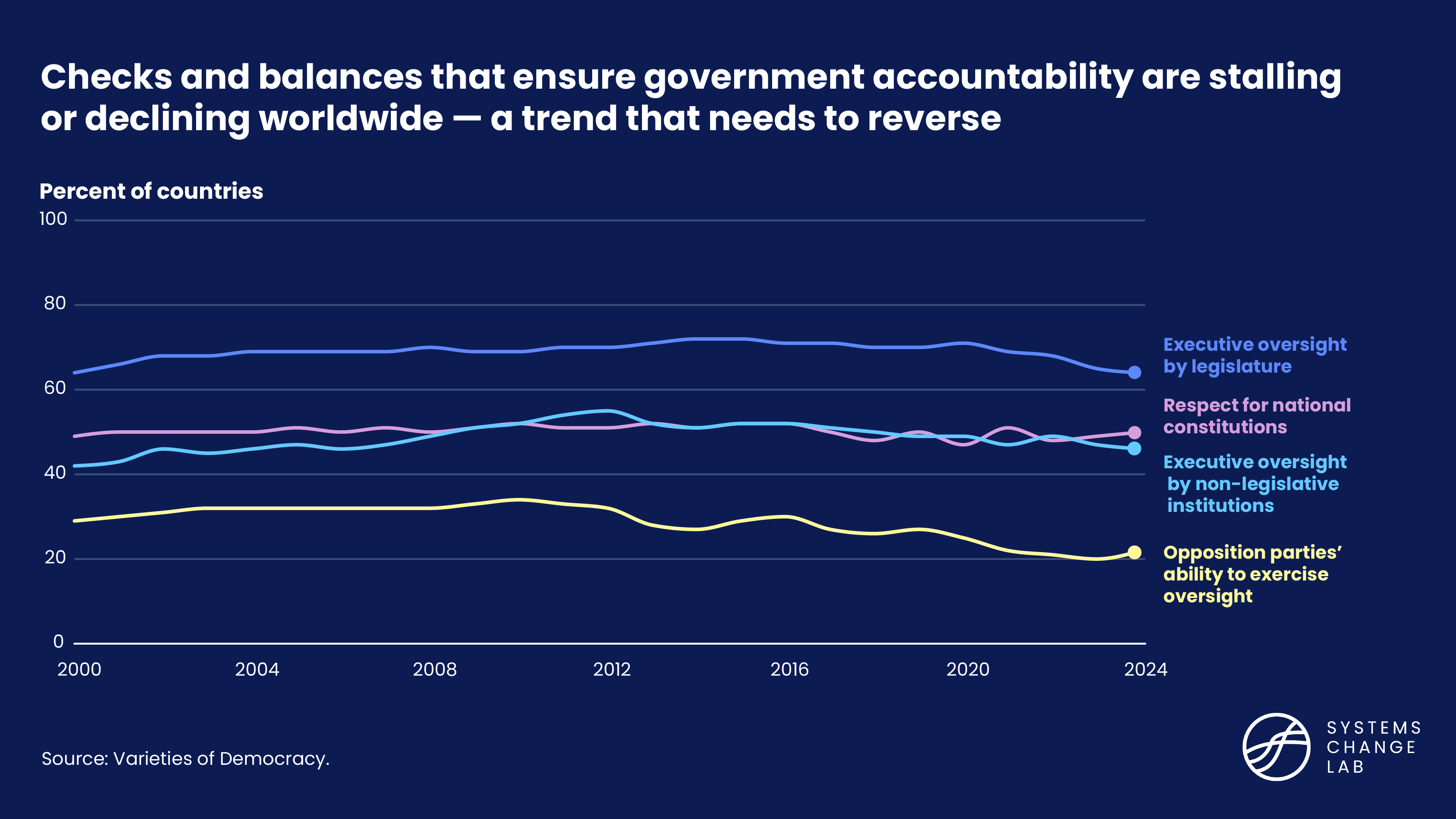
Disaggregated data depicting the stalling and declining of government accountability

Accurately assessing government capacities identifies areas for improvement toward impactful and equitable policies

Assessing government capacity includes considering their statistical capacity to assess their own progress and gaps, taking into account technical capacities such as data monitoring and management and planning. In 2024, the world’s average score on open and accessible statistical systems — needed for adequate statistical capacity to plan and track progress toward reaching policy goals for people, nature and climate — was just 56 out of a possible high of 100. Nonetheless, this global average is trending in the right direction, up from 32 in 2015.

Effective policy implementation also requires bureaucratic cultures that promote the public interest and develop adaptive and flexible approaches to planning and regulations. Therefore, this shift also considers governments’ institutional and political economic capacity to align the interests of political elites with climate, nature and social equity goals. This level of state capacity entails political and bureaucratic leadership, institutional arrangements, incentive structures, and the ability and willingness to enforce compliance.

These have long been areas of focus for development practitioners, and some improvements are evident in recent years — as seen in indicators tracking state capacity to implement political priorities, national data management capacity and countries' fragility and risk of conflict. However, challenges in delivering services effectively are still pervasive.

Moving forward, the need for systems change and technological innovation presents new capacity challenges in the form of regulatory, planning and management adaptivity and flexibility. Evidence suggests that countries should focus on organizational leadership, empowering civil servants and creating incentives to encourage experimentation.


The indicators presented in this shift are all directional, with an increasing trend indicating improvements in government capacity. While there are no specified global targets or timeframes, climate and nature commitments can only be implemented fairly and effectively if these key measures of state capacity show rapid improvement.

Tracking progress on global outcomes

5420: Countries demonstrating capacity to implement political priorities

Status: Right Direction
Historical Data Methodology and Challenges:

Number of countries included in the study between 2000-2023: 145 countries. The latest edition of the Berggruen Governance Index report was published in 2026 and covers data through 2023. Annual global average scores were calculated by averaging all country scores for the given year.

The Berggruen Institute’s global index of 145 countries is comprised of numerous indicators that together speak to the likely capacity — or political economy — of governments to implement their policy commitments in a timely and effective manner. The indicators assess, for instance, if governments allocate sufficient resources (as a percent of GDP), are perceived by experts as having low levels of embezzlement and theft of public sector resources, maintain transparent laws with predictable enforcement, and have effective territorial authority.

In 2023, the mean score of 145 countries in the Berggruen Governance Index was 53 out of 100. This score has remained unchanged since 2019 and increased by only two points since 2000.

3474: Countries demonstrating adequate coordination capacity of government authorities

Status: Wrong Direction
Historical Data Methodology and Challenges:

Number of countries included in the study in 2000-2023: 145 countries. The latest edition of the Berggruen Governance Index report was published in 2026 and covers data through 2023. Annual global average scores were calculated by averaging all country scores for the given year.

Using data from the Varieties of Democracy (V-Dem) Institute, the Berggruen Institute provides a global index with data from 145 countries to assess, among other things, to what extent public administrations are rule-based and operate under a culture of ethics and integrity. This includes whether they are adequately resourced, hire staff based on merit, exhibit integrity in decision-making or exhibit cronyism or behavior that benefits particular interest groups more so than the broader public.

This indicator focuses on strong administrative capacity, which enables effective coordination across ministries and between national and subnational actors, and is essential to delivering the types of ambitious policies and actions necessary to spur systems change.

As of 2023, the mean global score for this indicator was 54 out of 100, a slight decrease from 55 experienced between 2014 and 2021. Notably, the global average remained nearly unchanged — hovering between 56 and 54 — from 2000 to 2023, suggesting important and persistent barriers for progress.

3479: Countries with developed statistical and data management capacity

Status: Right Direction
Historical Data Methodology and Challenges:

This data source measures the capacity and willingness of countries to develop data infrastructure (governance, financing and skills), data sources (censuses, surveys, etc.), data products (reporting on indicators), data services (responding to data requests and open data platforms) and data use (demand for data within the country). Annual global average scores were calculated by averaging all country scores for a given year.

The number of countries included in the study in 2016: 167 countries; 2017-2019: 174 countries; 2020-2021: 181 countries; 2022-2023: 186 countries.

This indicator measures the capacity and willingness of countries to develop effective data infrastructure, sources, products and services and put them to use across governments.

Monitoring, analyzing and reporting data and statistics is essential for understanding whether countries are on track to meet social and environmental targets. Data-driven governance, coupled with transparency, builds credibility on what informs government policy and budgetary priorities. Thus, this indicator is a proxy for government capacity to produce and publish quality data.

According to the World Bank, scores correlate with development indicators such as GDP, but countries can also out- or under-perform their level of development. As of 2023, the 186 countries surveyed by the World Bank averaged a score of 69 out of a possible 100, up from 62 in 2018 and 58 in 2016. This suggests that the indicator was heading in the right direction from 2016 to 2023 (the last year of data).

3475: Countries with fragility and conflict risk

Status: Right Direction
Historical Data Methodology and Challenges:

The data provider’s total score is based on twelve conflict risk indicators, ranging from 0 to a maximum of 120. Annual global average scores were calculated by averaging all country scores for a given year. 

Number of countries included in the study: 2012-2020: 178; 2021-2024: 179 countries.

Fragility at the country level is driven by geopolitical, economic, social, environmental and technological factors that can be inflicted from external actors, internal strife or a combination. Common manifestations of a fragile state include the inability to secure borders or monopolize the use of legitimate force, the erosion of legitimacy to make collective decisions, an inability to provide basic public services and inability to interact fully with other states in the international community.

Countries experiencing instability or fragility are less likely to develop and implement visions of social and economic development, collect taxes to fund public investments, prevent widespread violence or discrimination targeting specific groups, or invest in clean infrastructure and enforce laws — all of which are critical to enabling systems change for people, nature and climate.

The Fund for Peace annually assesses countries’ fragility and conflict risk in its Fragile States Index. The higher the score, the more that country is experiencing different types of pressures that contribute to a fragility to conflict, and therefore vulnerability to state collapse. In 2024, the global mean score was nearly 65 out of a possible 120 (based on the 179 countries included in the study), down from a score of nearly 71 in 2012 (based on 178 countries). The declining trend over the last five years indicates that, on average at a global scale, fragility and conflict is slightly decreasing.

3476: Countries' fiscal capacity

Status: Wrong Direction
Historical Data Methodology and Challenges:

Number of countries included in the study between 2000-2023: 145 countries. The latest edition of the Berggruen Governance Index report was published in 2026 and covers data through 2023. Annual global average scores were calculated by averaging all country scores for the given year.

Fiscal capacity is the state’s ability to extract or generate resources through different tax instruments while not being so constrained by interest payment on debt that it cannot make necessary short and long-term investments in public goods.

This indicator is based on the “fiscal capacity” sub-index from the Berggruen Governance Index and assesses countries based on four dimensions: tax revenue, tax administration, central bank reserves and interest payments. The sub-index draws data from the International Monetary Fund, World Bank and the Varieties of Democracy (V-Dem) Institute.

Based on 145 countries assessed in 2023 (the latest year for which Berggruen Governance Index data is available), the global mean score for this sub-index was 31 out of a possible 100 maximum score. Global mean scores have remained nearly unchanged since 2000, when the global score was 29, and then remained at 31 between 2013 and 2023, revealing persistent barriers to progress. The data suggest this indicator is headed in the wrong direction.

3482: Outcome-based regulatory approaches with MEL systems in place

Status: Insufficient Data

Outcome-based regulation (as opposed to rule-based) is when governments provide clear social or environmental goals for businesses to achieve, with a flexible approach on how they arrive there. Traditional regulatory approaches often struggle to keep up with the pace of innovations, which can present risks to social well-being, ecosystems and a fair and competitive business environment.

The Organization for Economic Co-operation and Development (OECD) notes that innovation can be stimulated through outcomes-based regulatory approaches. Countries such as Sweden, the United Kingdom and Canada have proactively established bodies to reduce regulatory uncertainty and identify regulatory approaches for emerging technologies. This regulatory approach is forward-looking, experimental and focused on outcomes that maximize benefits across society, while minimizing risks. It also seeks to ensure transparency and public participation in the process, monitor the regulatory implications of major new innovations and promote a flexible and iterative approach to application.

In addition, civil servants, policymakers and others must put in place systems to monitor change, understand the impact of policies and shift course if necessary to respond to new information. A flexible approach is critical, given that uncertainty is inevitable in the timing, magnitude and types of impacts produced through the interaction of climate, ecosystems and human-induced stressors. Embracing this approach requires not only technical capacity building, but also supporting governance and learning structures that enable decision-makers to experiment and share data across sectors. Such learning structures also enable decision-makers to review policy and program mechanisms put in place to avoid or adapt to unintended consequences.

To our knowledge, there is not currently a methodology for assessing the implementation of these approaches at a country level.

3460: Share of countries that have published mid-century long-term low-emission strategies that include monitoring and reporting mechanisms

Status: Insufficient Data

The United Nations Framework Convention on Climate Change (UNFCCC) invited countries to submit long-term strategies (LTSs) that detail how they will reach net-zero emissions at or around mid-century. These strategies are important because — if they carry political weight and successfully influence short- and medium-term policymaking — they can provide a roadmap for policymakers and identify challenges and technological, finance and governance needs to ensure credibility. This requires political will, coordination capacity and the development of institutions to implement effectively.

The UNFCCC’s LTS portal tracks the number of country submissions (75 countries plus the European Union, as of mid-2025). A UNFCCC report from 2023 found that LTSs submitted thus far accounted for 76% of total emissions in 2019, 87% of the global total gross domestic product (GDP) and 68% of the total population.

The inclusion of a monitoring and review mechanism of the LTS is a further indication that countries are establishing institutions to ensure that these plans are regularly reviewed and influence agencies’ planning and regulatory approaches. The same UNFCCC report also found that 74% of LTSs submitted in 2023 presented formal arrangements for monitoring and reporting. However, the proportion of LTSs that include these arrangements has decreased over time, suggesting more recent submissions are lacking this mechanism for transparency and accountability.

Key enablers and barriers to change

Other shift Other shifts needed to transform the system

Enable a safe and secure environment for workers, civil society and communities

Equitable systems change is impossible without respect for human rights and civil liberties. These rights set the foundation for all people to access essential services, live in a safe and healthy environment, and participate fully in governance.

Ensure transparency and access to information

Transparency and access to information are essential for effective government coordination, meaningful participation from civil society and building international trust and cooperation.

Guarantee access to justice

An independent, impartial and accessible justice system is a critical tool for individuals and communities to protect their rights and obtain justice.

Promote government accountability and anti-corruption measures

To implement ambitious policies effectively and mobilize public finance for climate, nature and equity, governments must follow through on commitments and enforce laws consistently — even for those with political and economic power.

Ensure inclusive citizen participation in policymaking and political processes

The ability of any individual or social group to participate meaningfully in political and policymaking processes is a fundamental recognized human right — and a powerful way to advance the voices of those most affected by climate change, social inequality and loss of nature.